Thursday, 22 December 2016
Saturday, 17 September 2016
Saturday, 1 August 2015


Thursday, 9 July 2015
Monday, 6 July 2015

Thursday, 25 June 2015

Tuesday, 23 June 2015
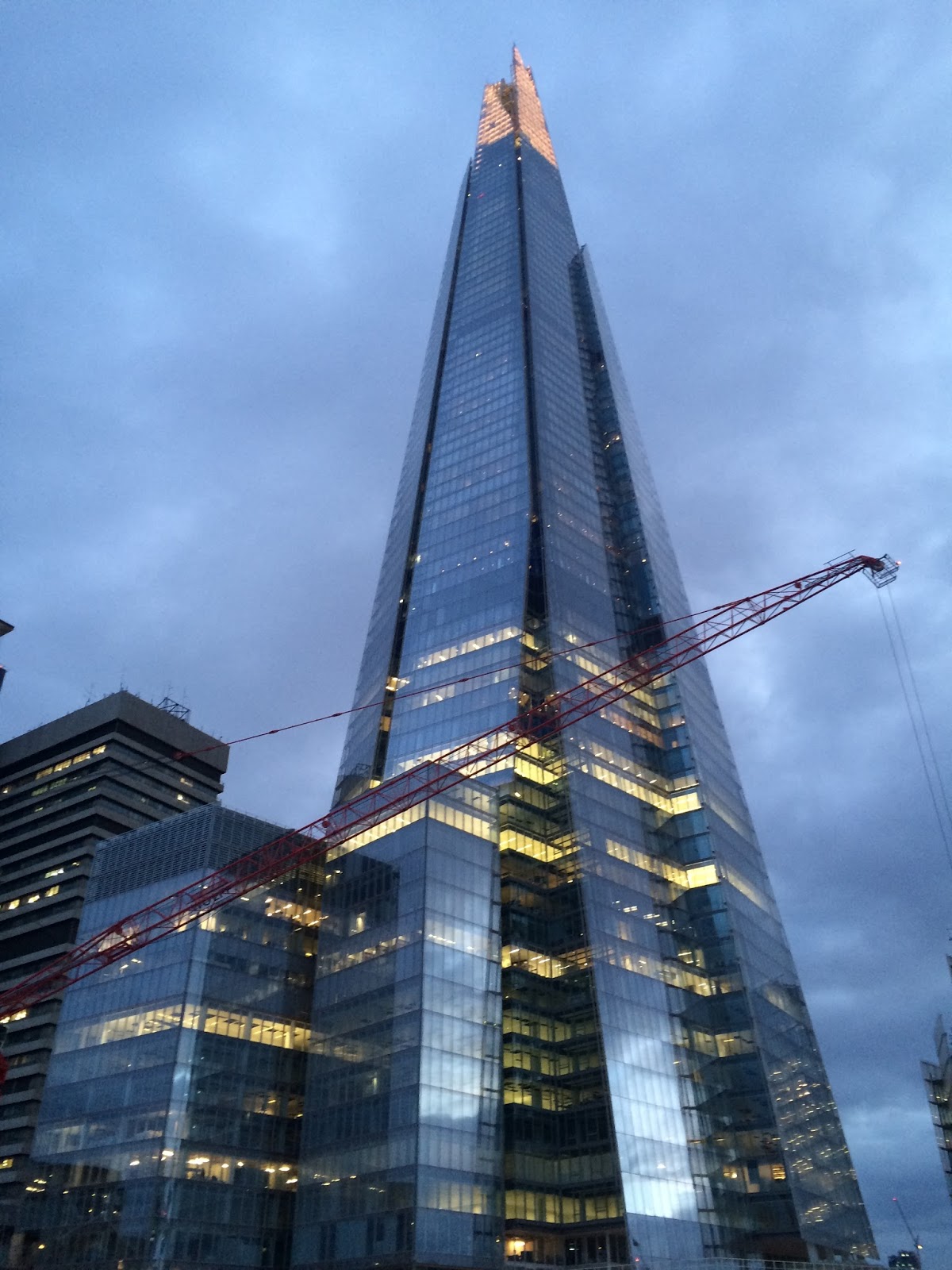
The Shard (Tallest Building in UK)
The Shard, also referred to as the Shard of Glass, Shard London Bridge and formerly London Bridge Tower, is a 95-storey skyscraper in Southwark, London, that forms part of the London Bridge Quarter development. The Shard's construction began in March 2009; it was topped out on 30 March 2012 and inaugurated on 5 July 2012. Practical completion was achieved in November 2012. The tower's privately operated observation deck, The View from The Shard, was opened to the public on 1 February 2013.

Standing 309.6 metres (1,016 ft) high, The Shard is currently the tallest building in the European Union. It is also thesecond-tallest free-standing structure in the United Kingdom, after the concrete tower at the Emley Moor transmitting station. The glass-clad pyramidal tower has 72 habitable floors, with a viewing gallery and open-air observation deck on the 72nd floor, at a height of 244.3 metres (802 ft). It was designed by the Italian architect Renzo Piano and replacedSouthwark Towers, a 24-storey office block built on the site in 1975. The Shard was developed by Sellar Property on behalf of LBQ Ltd and is jointly owned by Sellar Property and the State of Qatar.


Dancing Road in Germany
Winter in Berlin, turning its cobble stone pavements into an ice skating ring. The below zero temperatures caught many civilians and tourist off guard, as many slipped and fell when exiting the train stations.
Before lunch time over 1,000 calls were made to the emergency services to report a fall, while police reported about 108 traffic accidents due to the capital's icy roads. The temperatures will only get colder with forecasts saying that it will reach -10 C by the end of the week
Saturday, 20 June 2015
Friday, 19 June 2015
SLC Result
Click the links for SLC Results
http://www.moe.gov.np
http://www.slc.ntc.net.np
http://results.ekantipur.com
http://www.moe.gov.np
http://www.slc.ntc.net.np
http://results.ekantipur.com
Sunday, 8 March 2015
Martyrs in Nepal
Martyr (Nepali: शहिद; Shahid) in Nepal is a term for some one who suffers is killed while making contributions for the welfare of the country or society. The term was originally used for individuals who died while opposing the Rana Regime which was in place in the Kingdom of Nepal from 1846 until 1951. Lakhan Thapa is regarded as the first martyr of Nepal.
Rebelled against Jung Bahadur Rana
(martyred in 1877 — "first martyr")
Lakhan Thapa Magar
Rebelled against Juddha Shamsher Jung Bahadur Rana
(martyred in 1941 — represented in the Shahid Gate)
Dharma Bhakta Mathema
Gangalal Shrestha
Dashrath Chand
Shukraraj Shastri

Note: Ramhari Sharma, founder of Nepal Praja Parishad, was not given the death sentence as he was a Brahmin, and is often called a "living martyr."
Did lil master
Pune: Nepal's Teriya Magar was announced the winner of Zee TV's 'DID L'il Masters' Season 3 here Saturday.
The 11-year-old from Rudrapur, Nepal, defeated Hardik Ruparel, Anushka Chetri and Sadhwin Shetty; and walked away with the KB3 Cup and Rs 10 lakh at the grand finale held at the Balewadi Sports Complex here.
"I am extremely happy to win this trophy today. It is like a dream come true for me to perform on the stage of 'DID L'il Masters' and emerge as a winner of Season 3. Masters and audiences have been really supportive and have appreciated my performances," Magar said in a statement.

On their winning the trophy of Season 3, Skipper Omkar Shinde said: "We gave our best to each performance on the coveted stage of 'DID'. My aim was to focus on Teriya's overall grooming to make her a well-rounded, versatile dancer rather than excelling in only one form which is considered her forte."
The dance reality show for children was also attended by Bollywood actor Varun Dhawan, who performed to a medley of his blockbuster songs like 'Main tera hero', 'Saturday saturday' and 'Disco diwane'.
He along with Grandmaster Mithun Chakraborty and the judges of the show - Geeta Kapoor and Ahmed Khan - presented the coveted KB3 Cup to Magar.
Congratulating the winner, Mithun said: "Heartiest congratulations to Teriya. Mentored by able skippers, the kids presented acts one could never have imagined children to be capable of delivering."
Copied from internet!
Womens Day
International Women's Day (IWD), also called International Working Women's Day, is celebrated on March 8 every year. In different regions the focus of the celebrations ranges from general celebration of respect, appreciation and love towards women to a celebration for women's economic, political, and social achievements


Tuesday, 3 March 2015
Tuesday, 17 February 2015
Maha ShivaRatri
Maha Shivaratri is a Hindu festival celebrated annually in reverence of the god Shiva. It is the day Shiva was married to the goddess Parvati. The Maha Shivaratri festival, also popularly known as 'Shivaratri' (spelt as Sivaratri, Shivaratri, Sivarathri, and Shivarathri) or 'Great Night of Shiva', marks the convergence of Shiva and Shakti. Maha Shivaratri is celebrated on the Krishna Paksha Chaturdashi of Hindu calendar month Maagha as per Amavasya-ant month calculation. As per Poornima-ant month calculation, the day is Krishna Paksha Chaturdashi of Hindu calendar month Phalguna which falls in February or March as per the Gregorian calendar. Of the twelve Shivaratris in the year, the Maha Shivarathri is the most holy.

 The festival is principally celebrated by offerings of Bael leaves to Shiva, all-day fasting and an all-night-vigil (jagaran). All through the day, devotees chant "Om Namah Shivaya", the sacred mantra of Shiva. Penances are performed in order to gain boons in the practice of Yoga and meditation, in order to reach life's highest good steadily and swiftly. On this day, the planetary positions in the Northern hemisphere act as potent catalysts to help a person raise his or her spiritual energy more easily. The benefits of powerful ancient Sanskrit mantras such as Maha Mrityunjaya Mantra increase greatly on this night.
In Nepal, millions of Hindus attend Shivaratri together from different part of the world at the famous Pashupatinath Temple. Thousands of devotees also attend Mahasivaratri at the famous Shiva Shakti Peetham of Nepal.
Sunday, 17 August 2014
Thursday, 14 August 2014
Saturday, 9 August 2014
Janai Purnima
In Nepal, Raksha Bandhan is celebrated on shravan purnima. It is also called Janai Purnima (Janai is sacred thread and purnima means full moon). A sacred thread is tied on wrist by senior family members and relatives. Nepalese people enjoy this festival, eating its special food "Kwati", a soup of sprout of seven different grains.

Thursday, 31 July 2014

Saturday, 12 July 2014
Guru Purnima


In addition to having religious importance, this festival has great importance for Indian academics and scholars. Indian academics celebrate this day by thanking their teachers as well as remembering past teachers and scholars.
Traditionally the festival is celebrated by Buddhists in honor of the lord Buddha who gave His first sermon on this day at Sarnath, Uttar Pradesh, India. In the yogic tradition, the day is celebrated as the occasion when Shiva became the first Guru, as he began the transmission of yoga to the Saptarishis Many Hindus celebrate the day in honor of the great sage Vyasa, who is seen as one of the greatest gurus in ancient Hindu traditions and a symbol of the Guru-shishya tradition. Vyasa was not only believed to have been born on this day, but also to have started writing the Brahma Sutras on ashadha sudha padyami, which ends on this day. Their recitations are a dedication to him, and are organised on this day, which is also known as Vyasa Purnima. The festival is common to all spiritual traditions in Hinduism, where it is an expression of gratitude toward the teacher by his/her disciple.[8] Hindu ascetics and wandering monks (sanyasis), observe this day by offering puja to the Guru, during the Chaturmas, a four-month period during the rainy season, when they choose seclusion and stay at one chosen place; some also give discourses to the local public. Students of Indian classical music, which also follows the Guru shishya parampara, celebrate this holy festival around the world.
Copied from wikipedia!
Subscribe to:
Posts (Atom)